
The annual conference for the UN treaty took place in the middle two weeks of November. The first week largely involves formal work and statement by Government ministers and Presidents, while the second week gave many opportunities for contribution to panels and documents. COP29 of UNFCCC is arguably the highest profile event with impact on global future anywhere in the world in 2024. The University of Leicester became an officially recognized “Observer” at COP29 for the first time, and we were part of the RINGO Research and Independent Non-Governmental Organizations community, and the Farmers @COP29 group. The research represented by me included many aspects of agricultural genetics, and for collaborations and training of students and researchers from more than 25 countries.
Pat Heslop-Harrison phh4(a)le.ac.uk 1 December 2024

I had two pre-planned messages to get across at COP29, building from conclusions from our research with many collaborators on biodiversity, genetics and breeding.
Message 1: Agriculture has been enormously successful with increasing production to feed the world’s population over the last 60 years, with a decreasing proportion of people being undernourished, despite the well-known hugely increasing population. About half the improvement comes from the genetics of farm animals and crops; and half from improved management. However, the production increase has been at the expense of destruction of the environment. Now, perhaps for the first time in millennia (outside Africa) globally there is no meaningful increase in human population, an important fact not recognized by most people. Therefore, we can put the continuing 0.75% increase in agricultural productivity that has been achieved in the last century towards making production more sustainable.

After a discussion meeting on Farming and Agriculture at COP29
Message 2: Tertiary, University graduate-level, education is critical to solving the issues of Climate Change – both mitigation (reduction or capture of emissions) and adaptation (changing approaches for living with climate change). The skill set which can be delivered by advanced training, globally, is essential to allow societies to develop innovative solutions, implement effective policies, and build resilience against the impacts of a changing climate. Tertiary education allows research and innovation, drives technological advancements, and prepares leaders in sustainable and equitable development. Unlike finance, education cannot be misused or corrupted and is self-maintaining. Tertiary education will complement the Sustainable Development Goals around school education.
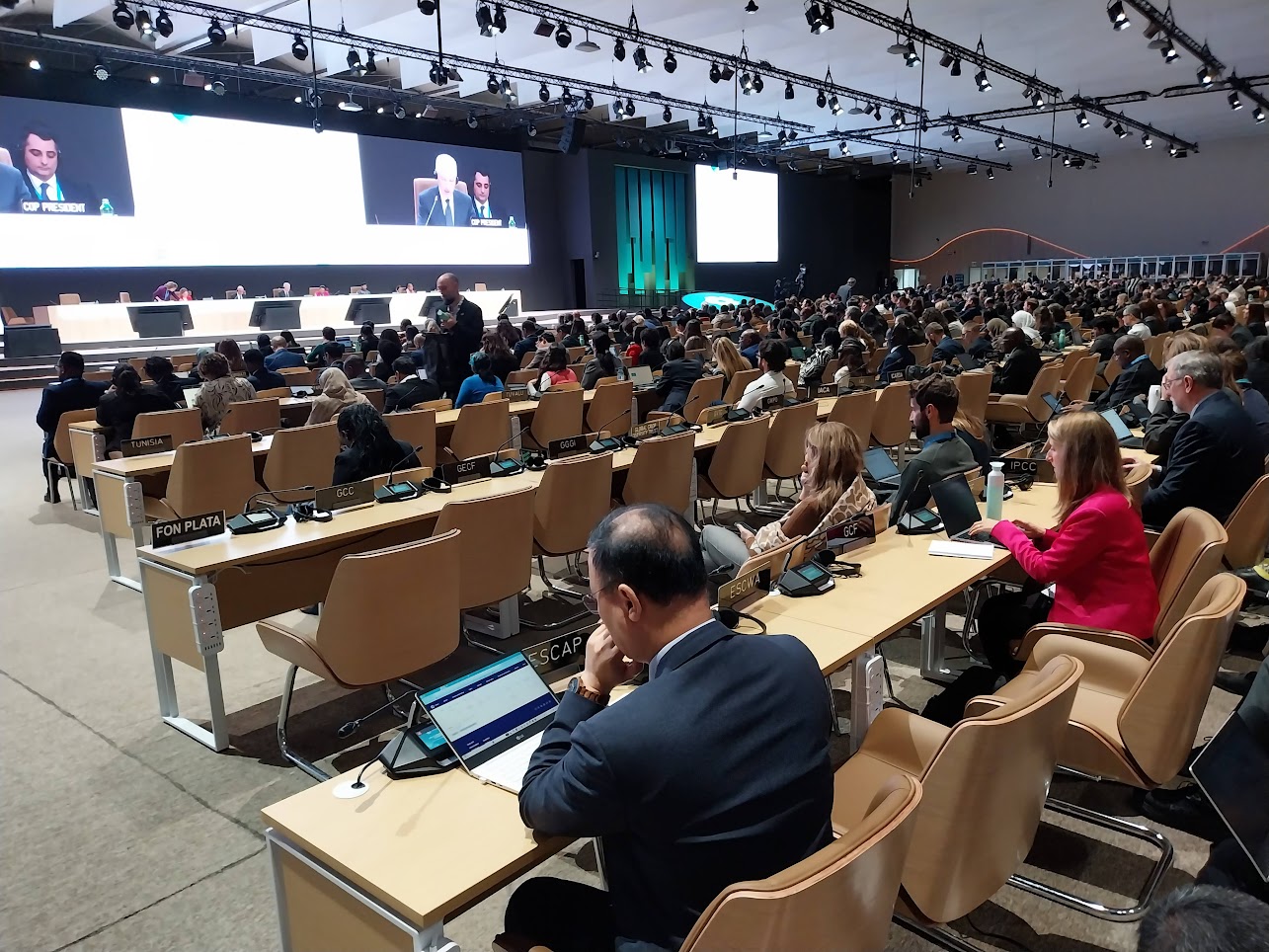
A policy-making session at COP29
 Molecular cytogenetics, genome evolution and agricultural genomics