My job has three parts: 1) Research in biodiversity and agricultural genetics; 2) Critical evaluation of other research through journals and reviews; and, perhaps most imprtantly, 3) Telling people about the value, interest and importance of the natural and agricultural environment. I was delighted to visit Dinghu, the first Chinese National Nature Reserve, founded in 1956, and part of the South China National Botanical Garden (SCBG or SCNBG) of the CAS (Chinese Academy of Sciences) in Guangzhou, south China, to present a science lecture on Biodiversity, Conservation and Agriculture. Below are links to new reports about my talk, and the full set of slides is on Slideshare (only the first slide is in Chinese!).

With an audience of about 400 people, and translation by Flora, I had an excellent series of questions at the end. I could make my key points about the success of agriculture in producing food for the hugely increasing population of the world over the last century. This has been achieved without using more land nor exploiting wild-collection, but has been at an unsustainable cost to the environment, biodiversity and climate. But now that the global population is stabilizing, we can continue to improvement of about 1% per year in agricultural productivity, but use this to improve the environment and sustustinability of agriculture. We can increase productivity in fields, enabling more area to be devoted to biodiversity conservation, while improving the ecosystem services from farmland.
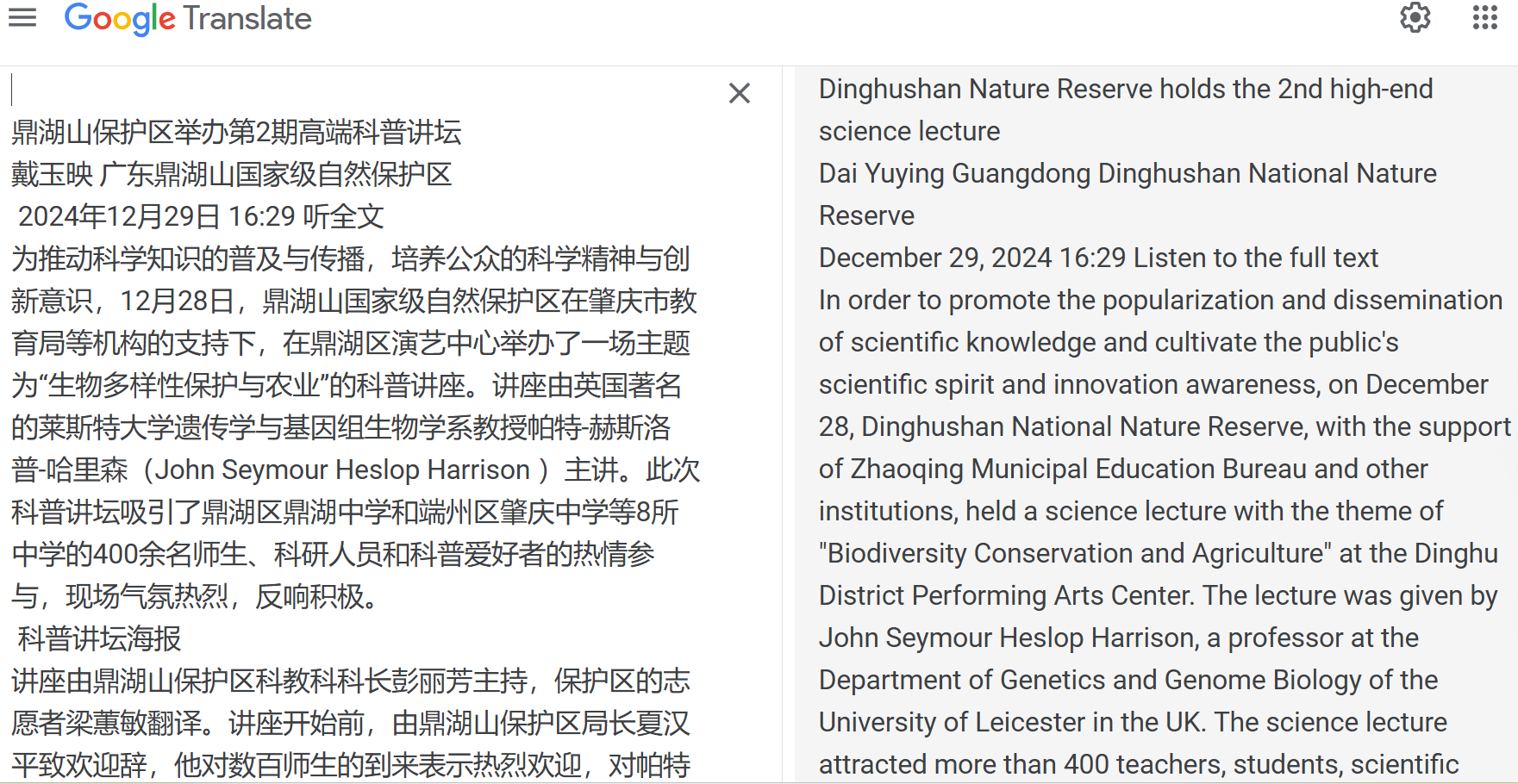
A news report about my talk is
https://zqh5.xjrb.com/h5/nfzmy-video-share/index.html
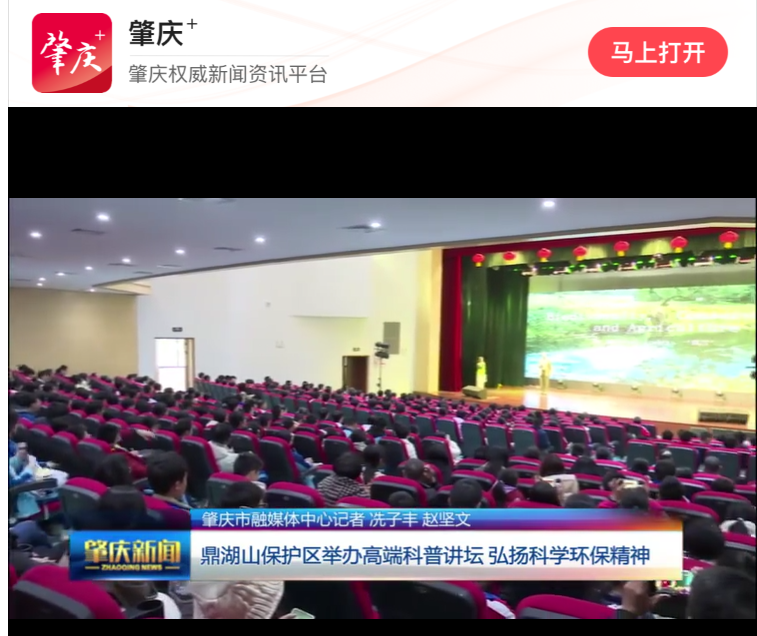

Transcript from Television programme:
This morning, Dinghu Mountain National and Nature Reserve, with the support of Zhaoqing Municipal Education Bureau and other institutions, held the second high-end science popularization forum, inviting Pat Heslop-Harrison, Professor of the Department of Genetics and Genome Biology at the University of Leicester, UK. Pat Heslop-Harrison explained the close relationship between biodiversity conservation and agriculture, attracting the active participation of more than 400 teachers, students, scientific researchers and science. A student comments “We also come across some scientific and hands-on spirit at any time, which will inspire us to continue to study in the future, and to contribute to society”, and “to create some Communist Party protected areas.” It is also an important scientific research base at home and abroad, attracting many domestic and foreign experts and scholars every year who come for scientific research cooperation and exchange, share the latest research results and technologies, and promote science The development of the South China Botanical Garden of the Chinese Academy of Sciences in 2023 includes a commitment to jointly promote in-depth cooperation in natural resource protection, scientific research and popular science education, and strive to build a high-quality, high-standard ecological civilization demonstration area, making new contributions to the construction of ecological civilization in Zhaoqing. Contribution, reported by Xian Zifeng, reporter of Zhaoqing Rong Media Center.
Another report, automatically translated from Chinese, Describes other parts of my talk:
The lecture was hosted by Peng Lifang, head of the Science and Education Department of Dinghushan Nature Reserve, and translated by Liang Huimin (Fiona), a volunteer of the reserve. Before the lecture began, Xia Hanping, director of the Dinghushan Nature Reserve, delivered a welcome speech. He warmly welcomed the arrival of hundreds of teachers and students and expressed his sincere gratitude to Professor Pat for his visit and guidance.
Xia Hanping delivered a speech. The atmosphere was warm and the response was positive.
The title of Professor Pat’s lecture was “Biodiversity Conservation and Agriculture”. After the lecture began, he invited the students present to cooperate in science, and asked them how to ensure food production and solve the problem of food and clothing for the world’s population on the basis of protecting biodiversity as much as possible. He also led everyone into the scientific research world of new germplasm development, guided the public to understand the genetic laws of adapting to environmental changes and biodiversity protection, and explained the close relationship between biodiversity protection and agriculture in an easy-to-understand way. At the same time, he profoundly introduced the human needs for poverty alleviation and mitigation of global climate change, and emphasized that protecting biodiversity is an important mission of global citizens. During the lecture, Professor Pat interacted enthusiastically with the participating public to understand the public’s understanding and views on biodiversity conservation. In order to enhance interactivity, a popular science knowledge question-and-answer session was also arranged on the spot. The public actively participated and asked questions enthusiastically, and the atmosphere was warm, which further enhanced everyone’s interest in scientific exploration. This popular science forum not only provides the public with a platform for face-to-face communication with overseas experts, but also enhances everyone’s understanding and love of biodiversity.
Interactive session
It is worth mentioning that Pat’s father, while serving as the director of the famous British botanical garden Kew, also visited China in 1975 and came to Dinghushan Nature Reserve for a scientific visit.
Dinghushan Nature Reserve is managed by the South China Botanical Garden of the Chinese Academy of Sciences. It is the only reserve affiliated with the Chinese Academy of Sciences. It is also an important scientific research base at home and abroad. Every year, it attracts many domestic and foreign experts and scholars to conduct scientific research cooperation and exchanges. These experts and scholars have rich experience and expertise in their respective fields. Through short-term or long-term visits, they can conduct in-depth cooperation with the research teams of the South China Botanical Garden and Dinghushan Nature Reserve, share the latest research results and technologies, and promote scientific development. In 2023, the South China Botanical Garden of the Chinese Academy of Sciences and the People’s Government of Zhaoqing City will start the joint construction of the “Dinghushan Ecological Civilization Demonstration Zone” project, including commitment to jointly promote in-depth cooperation in natural resource protection, scientific research and popular science education, so as to strive to build a high-quality and high-standard ecological civilization demonstration zone and make new contributions to the ecological civilization construction in Zhaoqing area.
Pat Heslop Harrison (John Seymour Heslop Harrison) Resume
Education and job background:
Pat Heslop Harrison (John Seymour Heslop-Harrison), colleagues call him Pat, is a professor in the Department of Genetics and Genomic Biology at the University of Leicester, UK. His research fields are plant molecular cytogenetics and genomics. Since the 1990s, he has been communicating and cooperating with the South China Botanical Garden. From 2018 to 2023, with the help of the Overseas Well-known Scholars Program, he and Associate Researcher Liu Qing of the South China Botanical Garden established a germplasm resource laboratory to contribute to the research and practice in related fields.
Academic contribution and social impact:
Professor Pat’s research contributes to the basic scientific issues of new germplasm development, genetic laws of adaptation to environmental changes, biodiversity conservation, and chromosome evolution, while also addressing the human needs of poverty alleviation and mitigation of global climate change.
Academic positions and honors:
He was the president of the Society of Experimental Biology (SEB, 2009-2011), and is currently a member of the board of directors of the European Cytogeneticists Association (ECA). He also holds important positions in several academic journals, including editor-in-chief of Annals of Botany (2008-2021), co-editor-in-chief of Biological Diversity (2024 to present), and special editor of Theoretical and Applied Genetics, a cutting-edge journal in the field of genetics.
He is also a member of several British and international funding and institutional review bodies, including the UK REF (Research Excellence Framework) and the CAS Institute Evaluation Committee of the Czech Academy of Sciences.
International cooperation and honors:
Professor Pat has received the International Visiting Scholar Program of the Chinese Academy of Sciences twice (2016 and 2024-2025).
Text/Dai Yuying
Photo/Li Rurong (volunteer), Dai Yuying
Review/Peng Lifang, Xia Hanping
 Molecular cytogenetics, genome evolution and agricultural genomics