Phylogeny and biodiversity of Elymus sensu lato using molecular and cytogenetic approaches
Negar Karimi is a PhD student in Plant Biosystematics at the University of Isfahan, Iran. She obtained her MSc from the same university, where she studied the taxonomy and genetic diversity of Sorghum L. in Iran. Her current research focuses on the phylogeny and biodiversity of Elymus sensu lato using molecular and cytogenetic approaches, under the co-supervision of Prof. Pat Heslop-Harrison. She is particularly interested in how cytogenetic and molecular data can clarify the evolutionary relationships and species delimitation within complex plant groups.
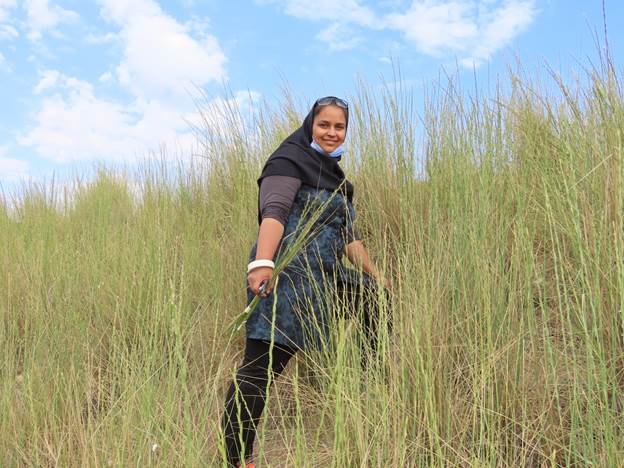
Negar with a population of Elymus elongatus sub. species ponticus in West of Iran; photo by: Saeidi
Elymus is in the grass tribe Triticeae, and hence, along with multiple genera which can be included among the sensu lato (such as Thinopyrum, Leymus, Kengyilia, Pseudoroegneria, Roegneria, Campiostachys) is a valuable source of characteristics to introgress into barley, wheat and rye. As a genus, Elymus is a very large, polyphyletic assemblage of perennial allopolyploid grasses united by a shared basic St genome.
We are planning several publications. The first one reports the chloroplast of Elymus ciliaris. Remarkably, using long molecular sequencing, we showed that there were two orientations of the Short Single Copy region of the genome, flanked by the inverted repeats. Other than this polymorphism, as is well known, there are no polymorphisms (SNPs) in the chloroplast from a single plant – hence why, in contrast to nuclear sequences, there is only on chloroplast genome sequence in databases for one plant.
Over the years, our Agricultural Genomics and Molecular Cytogenetics group has worked with many of these wild wheat species (alien) introgression lines. Chetan Patokar and Niaz Ali worked on wheat-Thinopyrum lines in our lab, and the Mace wheat variety was studied with Bob Greybosch from USDA, Nebraska. Even earlier, Marian Orgaard worked with diversity of Leymus lines.
Chetan Patoker (wheat-Thinopyrum lines from CIMMYT – sometimes called Ponticum lines)
Patokar C, Sepsi A, Schwarzacher T, Kishii M, Heslop-Harrison JS. 2016. Molecular cytogenetic characterization of novel wheat–Thinopyrum bessarabicum recombinant lines carrying intercalary translocations. Chromosoma 125: 163–172. https://doi.org/10.1007/s00412-015-0537-6
Niaz Ali (wheat-Thinopyrum bessarabicum/WSMV resistance)
Ali N, Heslop-Harrison JS, Ahmad H, Graybosch RA, Hein GL, Schwarzacher T. 2016. Introgression of chromosome segments from multiple alien species in wheat breeding lines with wheat streak mosaic virus resistance. Heredity 117: 114–123. https://doi.org/10.1038/hdy.2016.36
Robert A. Graybosch (Mace wheat)
Graybosch RA, Peterson CJ, Baenziger PS, Baltensperger DD, Nelson LA, Jin Y, Kolmer J, Seabourn B, French R, Hein G, Martin TJ, Beecher B, Schwarzacher T, Heslop-Harrison P. 2009. Registration of ‘Mace’ hard red winter wheat. Journal of Plant Registrations 3: 51–56. https://doi.org/10.3198/jpr2008.06.0345crc
Marian Ørgaard (Leymus diversity and relationships)
Ørgaard M, Heslop-Harrison JS. 1994. Relationships between species of Leymus, Psathyrostachys, and Hordeum (Poaceae, Triticeae) inferred from Southern hybridization of genomic and cloned DNA probes. Plant Systematics and Evolution 189: 217–231. https://doi.org/10.1007/BF00939728
Ørgaard M, Heslop-Harrison JS. 1994. Investigations of genome relationships between Leymus, Psathyrostachys and Hordeum inferred by genomic DNA in situ hybridization. Annals of Botany 73: 195–203. https://doi.org/10.1006/anbo.1994.1023

